As I have insinuated before, the
1970s has been unfairly derided as a time of “mellow” tastes. I mean, this was
the decade of Watergate, the oil embargo, the Munich Olympics hostage crisis,
the American Indian Movement, the Weather Underground, the Iranian hostage
crisis, Jimmy Carter’s “malaise” speech—real fun times. The only thing that
kept people from losing their minds was that it was the decade with the best
popular music. Films, on the other hand, did reflect the reality of the times, especially the paranoid
thrillers, like The Parallax View, The Long Goodbye, Chinatown, Night Moves
and—although it wasn’t released until 1981—possibly the best of them, Cutter’s Way.
Although it was released at the
turn of the decade, the sensibilities of Cutter’s
Way, directed by Ivan Passer, is unmistakably Seventies, which probably explained why it didn’t find
an audience at the time. It was time for Ronald Reagan’s “Morning in America,”
and filmgoers were not interested in being told how unfair life was. The
reality was that Cutter’s Way was more in-tuned with what was happening than people wanted to believe. The film's cynical view of how the rich and powerful got
away with their crimes while those on the lower end of the spectrum were
powerless to stop them or being victimized by them was even then about to be
confirmed and hastened by the Reagan administration’s policies which restarted
the massive of growth in the gap between the rich and everyone else.
Cutter’s Way opens with a parade
in Santa Barbara which proceeds in slow motion, accompanied by a haunting Jack
Nitzsche score, giving it an almost nightmarish quality which already suggests something sinister is afoot:
We sense from the start that
Richard Bone (Jeff Bridges) is a wastrel from a well-off background, doing "odd jobs" on the side like
small-time gigolo gigs, which isn’t fooling his older “client” who he asks for
a “loan” to help a “sick friend”:
Bone’s former and current state
of existence is apparent when the valet brings his car around; it is an
expensive Austin-Healey (a British sports car) that has seen better days. Of
course, the engine is bad too, so he uses that as an excuse not to leave a tip:
For some reason he ends up in an
alley where his car stalls in the pouring rain; while he is trying figure out
what to do, another car drives into the alley, and hoping for assistance,
Bone observes the profile of a man who gets out of the car, does something near some
garbage cans, and then drives off in a hurry:
Realizing he isn’t going to get
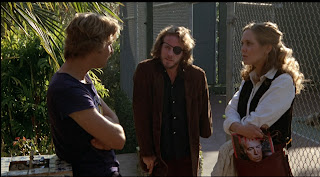
any help, Bone finds his friend Alex Cutter (John Heard) holding court in a
bar; Cutter is a badly crippled Vietnam War veteran:
He attracts the attention of two
black men playing pool after deliberately using a racial slur; Cutter asks them
what they expect him to call them these days, since the terms keep changing
over the years:
Bone scolds him on his apparent
racial insensitivity, but Cutter reminds him of the time he used racial slurs
when his car was stolen. Bone leaves the bar and visits the home of Cutter’s
neurotic wife, Mo (Lisa Eichhorn), who has had to deal the Cutter’s anger at
the world, and to help her get through the day is working on her second bottle of Vodka:
Mo critiques Bone’s life style,
and reminds him that it isn’t such a bad thing to have a place to go when he
doesn’t have anywhere else. Bone, however, mistakes her reaching out her hand
as a gesture of shared humanity; but she only wants the bottle back:
Mo claims that despite the way
things turned out, she still would have married Cutter rather than Bone; she says,
perhaps more as a critique of Bone rather than her life with Cutter, that she's “real happy” about the way things
“turned out.” Meanwhile the garbage men discover the body of a teenage girl
in one of the garbage cans in the alley:
Bone’s car is still there, which
of course makes him either a suspect or a witness:
George Swanson (Arthur
Rosenberg), a mutual friend, brings Cutter home after being out the entire
night:
George seems to have a guilt
complex in regard to Cutter for some reason, and he is needled about trying to
be a “saint,” which he needs Cutter to be one:
After Cutter makes insinuations
of Bone and Mo having sexual relations behind his back…
…detectives arrive to request
Bone’s presence at the station for questioning:
Bone insists he didn’t see a
face, or anything except in silhouette because of the darkness:
Meeting the sister of the victim,
Valerie Duran (Ann Dusenbery) doesn’t jog his memory. During another parade,
Cutter comments on the hypocritical “celebration” of white supremacy and tries
to annoy Mo with comments about the teenage cheerleaders:
Then Bone sees a man on
horseback, which seems to remind him of something:
It is J.J. Cord (Stephen Elliot),
who is a rich oil baron:
He’s the man he saw that night,
Bone says:
However, when Cutter presses him
on the matter, Bone is no longer “sure”—belatedly realizing this may be
something too big for him to be involved in. Later at a restaurant, they
discuss the matter, with Cutter pointing out the circumstantial evidence—including
Cord’s car mysteriously getting torched 90 minutes after the time Bone observed
the incident. This suggests the possible guilt of Cord, but Bone now says it is
just Cutter’s “imagination." Cutter, however, points out that Bone was certain it was him at one point:
That night Cutter deliberately
hits his neighbor’s car, who he apparently is not on good terms with. Cutter,
because of status as a war vet and a cripple, seems to think he has a “right”
to do these things:
When the police show up, Cutter manages
to get away with the fact he has an expired license and lapsed insurance by using
his war-related disabilities to his advantage for sympathy as he invents a story
explaining that it was an “honest mistake,” while the victimized party doesn’t
help his case by insulting the officer:
Soon, Cutter informs Bone that he has
been doing some investigating; the murder victim, Vickie Duran, was at a disco
club while Cord was across the street at the El Encanto hotel that night
attending an oil people reception, leaving around 11. What else did he find
out? That’s it?
Cutter insists that he is going
to uncover the truth, the world doesn’t have enough heroes. Bone says count
him out:
The next day while Bone is
playing tennis with George—who employs him as a part-time salesman at the
marina—Cutter shows up with the sister, Valerie:
They want to know if he’s changed
his mind about whether Cord is the guilty party or not. Of course he hasn’t,
and it’s “nice” that Cutter has gotten her involved in this scheme of his:
George offers to pay for lunch
for them at a new French restaurant, where Cutter further discusses his theory
about the murder. He claims to have read a quote from Cord, who said he liked
to pick up young hitchhikers for their “input.” Bone “congratulates” him on his
sleuthing ability; it’s an open-and-shut case now and he should take it to the DA
and he’ll even get a medal. But there is
more. Cutter found out that around midnight a man in a “funny hat” had purchased
two gallons of gas. Bone is unimpressed, but Cutter continues with a scenario
about happened: A drunk Cork picks up a cute teenybopper who demeaned his
sexual prowess, he hit her and accidentally killed her, dumped her body in the
alley, and purchased the gasoline to set his car on fire to hide the evidence:
A concerned George arrives to
warn them that the woman sitting at a nearby table…
…is Mrs. Cord (Patricia Donahue):
After they leave, Cutter and
Valerie reveal their “plan”: They are going to blackmail Cord; if he gives them
money to shut-up, it will prove that he is guilty and they will go to the
police. Bone, of course, thinks this is a crackpot scheme:
Bone and Valerie go on a boat
trip. They try to convince the other of their view of the matter, but neither
budge:
Later Bone and George discuss
Cutter’s bizarre ideas and vague threats. George says that Cutter demanded
$50,000 from him in exchange for not damaging his boats. They both agree that
he is “crazy”:
Bone then discovers Cutter and
Valerie composing a blackmail letter. He decides to get in on the scheme, probably
in the hopes of stopping this plan before it gets out of hand:
Mo, of course, thinks this is the
biggest load of BS that Cutter has come up with yet, but he is insistent that
this is about justice for the murdered girl:
The gang arrives at Cord’s
corporate headquarters, marveling at how high it goes, intimating Cord’s power:
Bone volunteers to go into the
building to deliver the letter personally to Cord, but with his dark sunglasses
and uncertain movements he draws suspicion from the security guard:
Bone eventually returns, and claims he
handed the letter to employee who promised to give the letter to Cord, and that
they are supposed to call back later:
Cutter and Valerie are excited
about getting some money, but Cutter
becomes impatient and uses his gun to “win” a prize at a shooting gallery to get it over with:
Bone calls a number in a
payphone. After the call he tells Cutter that it was “no dice,” that there was
no response from Cord. We suspect that he “faked” the call, but Cutter is
furious that Cord is so arrogant to think he can get away with murder. Bone
eventually tells him that he never actually gave the letter to anyone, and the
call was faked:
After Cutter goes into a rage, he
and Valerie leave to cook up another “plan”:
Meanwhile, Bone is back with Mo,
who seems to having nothing do in her life but get buzzed. Cutter calls to
inform them that he has given the letter to Cord himself. Whatever, "congratulations." Bone asks
Mo if she wants to sleep with him. Whatever, they have nothing left to lose:
Afterwards, Mo wonders now that
Bone has slept with her, that he has no use for her now, but he shouldn’t
concern himself about her feelings, because she knows what he is about. She
sometimes wonders if she is still alive sometimes, given the emptiness of her
existence, especially since Cutter never seems to be around. Bone assures her
that he won’t leave her this night…
…but of course he does what he does best, and when he thinks she
is asleep he slips away:
The morning finds him in his boat is putting
on an outfit to play polo, and George
arrives with some bad news:
After Bone had left, Cutter
and Mo’s house burned completely to the ground:
Cutter arrives with vengeance
written on his face; he knows who is responsible for this:
After identifying Mo’s body…
…at the polo match Cutter accuses
Bone as being the reason why Mo was killed. “They” saw his picture in the
papers and at the Cord building, and Cord was having him watched, and intended
to kill him. “They” set the house on fire, but “they” had assumed he was still
in the house but did not notice that he had left. What was Cutter going to do
now? That doesn’t matter; what does matter is what Bone does with the time he has
left:
Cutter sees the arrogant Cord on
the field…
…and he rushes as best he can
across the field toward him, but is stopped by Bone:
Mrs. Cord is watching this, and
we suspect that she is not going to let this behavior go on any longer:
George calls in Bone, and being
an employee of the Cords he warns him that he and Cutter need to stop this
business now. Bone still insists that he is innocent and has no quarrel with
Cord. George reveals why he feels he “owes” Cutter, because after his mother
died, Cutter’s mother took him in. But he owes Cord as well for setting him up in
business, and this trouble is a whole different ball game. They play for keeps.
This is now serious, and he needs Bone to put a stop to it, which Bone agrees
to:
But no matter how many times he
insists he wants no further part of Cutter’s games, Bone still can’t help but
involve himself. He finds Cutter with a new plan, to confront Cord personally,
and he wants Bone there. Cutter reveals that George’s father once owned the
marina, and he wouldn’t sell to Cord. His wife was “offed” and he went after
Cord, but was beaten senseless and eventually died. Cord, to keep George from thinking of
revenge, put him through school and set him up at the marina:
After they have gone, George
arrives at the guest house and realizes with all the news clippings of Cord
about that something dangerous is afoot, rushes off to stop Cutter:
But with Bone acting as his
chauffeur, they are on their way to a house party at the Cords'. Bone tries one
more time to dissuade Cutter; whatever he has planned, it’s not going to bring
back Mo or assuage their guilt. But Cutter has a back-up plan if “talk” fails:
Cutter gets out of the car before
they reach the house. After he parks the car, Bone decides to look for Cutter
and stop him:
Mrs. Cord recognizes Bone, who
gives her a fake name. She hopes he has a good time, but is seen conversing
with a couple of security men to watch him:
Bone finds Cutter at the buffet
table, and tries to persuade him to give up his gun:
Instead, Cutter goes into the
house looking for Cord…
…and security catches up with
them…
…Cutter gets away…
…while Bone is nabbed…
…and Mrs. Cord hopes he isn’t
“hurt” by the punch in the stomach he has just received:
Meanwhile, Cutter escapes through
the crowd:
Bone is taken to Cord, who asks
what can be done to “satisfy” his friend, since what he is doing is very
“unpleasant.” Will talking to him do any good?
Meanwhile, security has tracked
Cutter to the stable…
…but he gets away on a horse…
…making his way to the house like the Lone Ranger on his white steed…
…and crashing through the window of
the very room that Bone and Cord are in:
Seeing Cutter dying on the floor,
Bone looks at Cord and says “It was you”:
Cord replies in a sinister tone “And what if it
were?”:
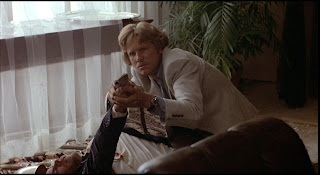
Holding Cutter’s gun in his hand
and pointing it at him…
…Bone watches Cord puts on his sunglasses,
which like at the parade reveals him in profile as the man Bone recognized in the alley…
…and the screen blacks out as we
hear a shot. We are left to ponder if Bone actually did kill Cord, that "good" triumphed over "evil."
Cutter’s Way, like many other films of its type, doesn’t have a
“happy” ending, and that is at it should be, because as in real life, nothing
really changes: the rich and powerful are still rich and powerful, and the poor
and powerless are still poor and powerless. Way never allows you for a minute
to believe all of this is going to end well; until the very end, Bone’s lack of
commitment leaves the viewer with the feeling that if left to the devices of a
seemingly deranged Cutter, there is no way that justice can be served. As much
as we admire Cutter’s commitment to justice, without a “sensible” hand to guide
him, there is no way that he can triumph against seemingly impossible odds.
There is a certain “sadness” that
permeates the film, since we know that this quest is bound not to end in real justice. Cutter
seems more than anything else motivated by revenge against those who sent him
to war and left him crippled. Yet even if we wanted to cheer him on, his
behavior is difficult to take, and he seems to want to make life impossible for those around him, including his wife. Bone on the other hand wants nothing to complicate his life, which
amounts to little but getting by having a good time and having nothing interfere with
that. When he does involve himself in Cutter’s schemes, he is more hinder than
help, and sometimes he makes things worse by his pretenses.
But the reality is that their quest was a fool's errand from the beginning. Even if Cutter and Bone did actually work together instead of at cross purposes, they were up against something
that they had no resources to fight on their own, especially since Bone did not cooperate with the police. They were up against a power that killed
before and had no qualms about doing so again, even the innocent like Mo. We
live in a society where seemingly the only recourse of the powerless against
the powerful is violence, but they are really just amateurs. The rich and
powerful can always find ways to dispose of those who wish to expose their
crimes, one way or the other.
While Cutter’s
Way allows us to believe that “justice” may (or may not) have been served
against all odds, that is not only not certain, but its cost was probably not
worth the effort. And we see even today, the rich (like Donald Trump) get away with their
crimes, and if you give them enough money, even Democrats-in-name-only will
forsake working people and serve the interests of the rich, and only increasing their power and immunity.