Thursday, June 24, 2021

Brits need a history refresher course to remind them that the Duke and Duchess of Sussex are hardly the worst "tarnishers" of the "brand"


CNN is reporting on another poll that purports to show that most Republicans support overturning the 2020 election. Do we need to belabor the point that most Republicans are generally anywhere from half-to-full crazed fascists? I think not.

Meanwhile, the other day “Dame” Joan Collins—they obviously give titles to anyone who is “famous” for any reason these days—refused to answer Piers Morgan’s query about claims that Meghan Markle was “lying” about  being refused help concerning her mental health issues. Collins claimed that she didn’t want to be “canceled” the way Morgan was if she gave her opinion, which she didn’t deny was not a “good” opinion. This interview was given on the new British “news” show GB News, which is the British equivalent of Newsmax and OAN, and has actually offended a few Brits because of its belly-flops into the UK’s “culture wars,” mainly with a “racialist” tincture.  

Of course what we are really talking about here with all this angst about Prince Harry and Meghan is the perception that it makes “The Firm” and British society look bad for chasing a mixed-race royal family member by marriage tearfully out of the country. Of course that isn’t hard to do, with the Windrush scandal still fresh and the continuing “hostile environment” policy. The “solution” to this problem seems to be to make Meghan look like the “bad guy” in all of this, at least from the British side.

The problem with all of this is that the Duke and Duchess of Sussex haven’t really done anything “wrong”; they say the British media had created a “hostile environment” for Meghan in particular, and “The Firm” did nothing to stop it. They were expected to “endure” it, and there can be little doubt that some members of “The Firm” actually enjoyed seeing it out of envy for the positive attention they received initially. The British media and others who have an “opinion” on the matter are making the apparently permanent move to the U.S. by the couple a national “scandal,” but again, this more about the way it “looks.” Harry and Meghan seem to be getting by just fine without all the bullshit, and many people in Britain just don’t like that.

But this isn’t the first time that British royals have been embroiled in “scandal,” and considerably more than the made up variety. History reminds us that King Edward VIII abdicated his throne to marry “the woman I love,” Wallace Simpson, an American not once, but twice, divorced, with the pair of them to be known as the Duke and Duchess of Windsor. But what they are more infamous for was their connection with the Nazi regime—the Duke for political and heritage reasons, and supposedly by the Duchess simply because she was treated like “royalty” on their tour of Germany in 1937, in contrast to being the subject of abuse in Britain.

But in fact, while the royal family did consider the match unsuitable, the British government was more concerned about where their loyalties lie. It was rumored that Simpson had a previous affair with the former ambassador and now Nazi foreign minister Joachim von Ribbentrop. Furthermore, despite the attempt by his father to whitewash any superficial trace of the fact that the British monarchy was more German than Anglo-Saxon genetically and culturally, Edward was quite proud of his German heritage, and believed its culture “superior” to Britain’s.

This was no “accident” either. The current regime of the British royalty, the House of Windsor, was originally called The House of Saxe-Coburg and Gotha, in reference to the hereditary claims of Prince Albert, the husband of Queen Victoria. This German House had succeeded another British royal dynasty of German origin: the House of Hanover. The latter was installed over the hereditary rights of the House of Stuart (which included the beheaded Charles I). The first British king of the House of Hanover, George I, was actually 52nd in line to the throne by blood, but because of the Act of Settlement passed by Parliament in 1701, Catholics were barred from the throne, and the German George was the closest “suitable” Protestant candidate of royal birth. His grandson, George III—who presided over the American Revolution—was the first of the Hanover line to actually speak English as his first language. Thus it shouldn’t come as too surprising that the British brought over German Hessian “mercenaries” to fight for them during the revolution.

Thus the Duke of Windsor didn’t see World War I as a reason to hate Germany, but as an impetus to find ways to be “friends” again and avoid another war. Unfortunately, this required embracing fascism, which many in Britain did, like Sir Oswald Mosley of the British Union of Fascists. The excuse for support of fascism was always to oppose the threat of “Communism.” Anti-Semitism was of course part of the ideology because of the supposed connection between Jews and communism, although anti-Semitism certainly predated that political ideology, and the British royal family was hardly immune from this feeling. The Duke hardly cared if Jews were under attack in Germany, since it was only the affair of Germany, and he even went so far to suggest that the British might be supportive of a dictator “soon.”

When he was heir to the throne, Edward’s support of fascism was particularly unsettling both to the government and the public at large, and some were “concerned” that his “accessibility” and “mock Cockney” pose might be taken advantage of by unscrupulous international players. He had already begun his relationship with Simpson by the time he assumed the throne in 1936, and some suspect that at least on government side, this union had to be opposed because it was a “security risk” to have a pair of Nazi supporters as heads of state. British and American intelligence had them under surveillance and wire-tapped before and after Edward abdicated the throne.

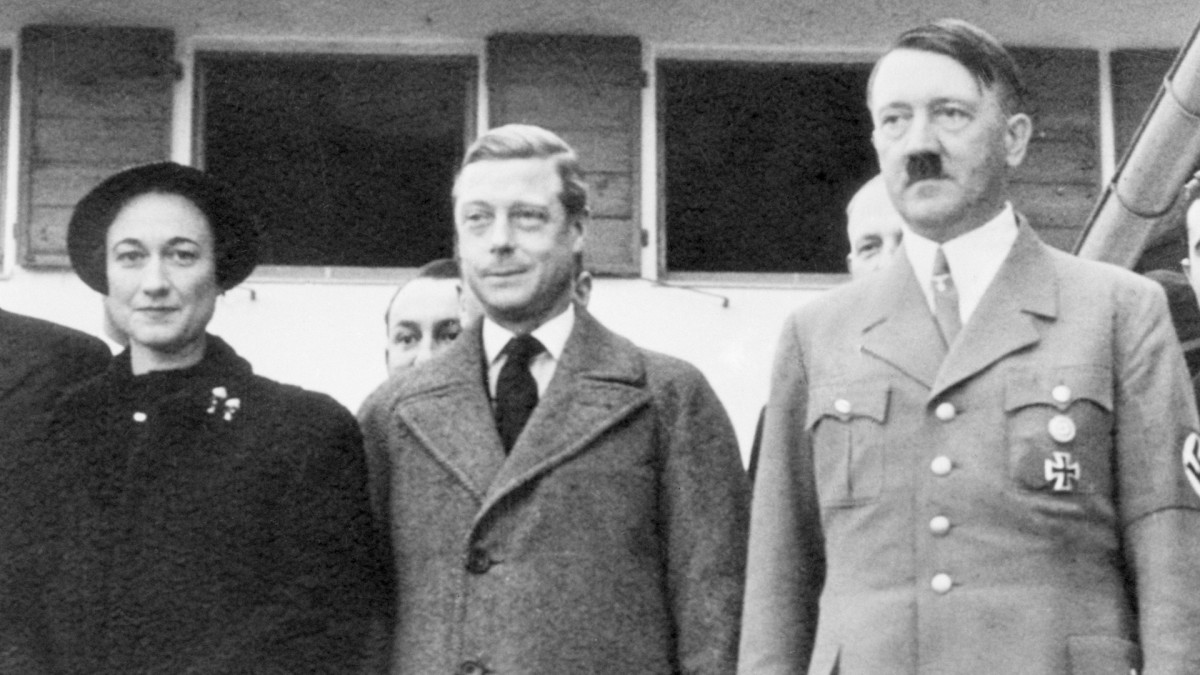
In his subsequent tour of Germany, the new Duke of Windsor was occasionally seen returning Nazi salutes to his German guests. He praised the regime's economic "miracles," not realizing that it's foundation was of the "voodoo" variety. The Duke and Duchess visited Hitler at the Berghof, and were reportedly “awestruck” by him—perhaps only just a little more than Hitler was by them; he was certainly “flattered” to be regarded on the same social level as a real British royal. The Duke, of course, would in his later autobiography be less generous in his estimation of Hitler. But one wonders what exactly he was thinking here:


Back home, people were dumbfounded by the Duke’s foolhardy embrace of the Nazis, completely unmindful of his own reputation; after all, his Germany-embracing cousin—the former Duke of Albany—was blacklisted as a “traitor peer.” A subsequent tour of the U.S. was canceled after Jewish groups protested his presence.

The Duke and Duchess were living in France when the war broke out; the Duke was given an honorary military rank, did some “reports” about French military readiness, and then the two fled to Spain and then Portugal when the Germans invaded France. Word got around that the Windsors were still tacitly supportive of the Nazis; according to once captured German telegram, the Duke  appeared to have hoped that the German bombing campaign over Britain would persuade the British to make “peace” with Germany. He also believed that if he was still king, there would be no war between their two countries.

This reached both Hitler’s and Winston Churchill’s ears. Churchill ordered the pair to take a position in the Bahamas to get them out of Europe before they got themselves into any more “trouble,” but Hitler had his own plan, called “Operation Willi,” in which the Duke and Duchess—either willingly or by force—would be “kidnapped” and held until the hoped-for success of Operation Sea Lion and the conquest of Britain, in which the Duke would be reinstalled as the figurehead king. But this never had any real chance of success, although it was reported that the Duchess was “intrigued” by the idea. Instead, the Windsors spent the rest of the war in the idyllic climes of the Caribbean beaches.

All this was subsequently excused by the Duke’s alleged lack of judgment, which was to be blamed for his giving-up his throne for a twice-divorced American, and relying on her and his friends to provide “improper” counsel. He was “naïve” and not equipped to deal with people like Hitler. But all this was “nothing” compared to the “shame” and embarrassment caused by one royal prince who has been completely written out of the British royal history narrative—the aforementioned Duke of Albany, Charles Edward. 

Born in 1883, Charles Edward’s father was the favorite son of Queen Victoria, but he suffered from the family curse of haemophilia, and would die from it after falling down a stairs before his son was born. While he was growing up, Charles Edward’s mother constantly admonished him not to bring shame on his father’s memory, which only made him nervous and easily intimidated. But as a minor prince far down the line of succession, he could look forward to a life of the idle rich, with only occasional ceremonial duties, which he apparently did not like do.

But that would change when he still a school boy at Eton. One day he was the Duke of Albany and the Earl of Clarence, and the next day he was the Duke of Saxe-Coburg and Gotha—meaning its seat in Germany. The duke who had borne that title, Alfred, was left with no male heir after the death of his son, and Queen Victoria was insistent that the duchy remain “in the family,” since it was the inheritance of her late husband. Although neither of the first two candidates wanted to go, they were unlikely to have worried about going anyways. Prince Arthur, Victoria’s third son, was actually rejected by the Kaiser because he served in the British Army. His son, also named Arthur, was next in line, but the Kaiser’s demand that the boy be German-educated was not acceptable to either the boy or his father. In any case, neither had any desire to abandon their carefree lives in Britain to live amongst a people who might not like them because they were not technically German.

The Queen had enough of this, and the next “in line” was going to go whether he liked it or not. Charles Edward was the next in line, and there are stories that his cousin threatened to thrash him if he didn’t accept the post; but in any case, Queen Victoria was angry she wasn’t getting her way, and put her foot down, ignoring the pleas of Charles Edward’s mother, who insisted he was needed to remain to oversee his British holdings, since he was the only living male heir. What the new German Duke inherited was a massive estate, with a huge house on the hill overlooking Coburg, plus numerous castles and farms that brought in the equivalent of $24 million a year in today’s money.

Still a teenager, Charles Edward’s life was controlled by the Kaiser, who forced him into a Prussian military school and an arranged marriage, although it was apparently a happy one. Charles Edward tried hard to convince the locals that he was a “good German” and not some British usurper whose allegiance was doubtful. As fate would have it, World War I broke out, and the Kaiser demanded that he serve in the German military; he was not allowed to sit this one out just because he didn’t want to fight the country of his birth and heritage. Charles Edward was allowed, however, to serve on the eastern front against the Russian Tsar, who was another one of his blood relatives.

Still, Charles Edward did have a “choice.” He still had his British titles, and he could have just abandoned his German holdings and started life over again like it had been destined to be before he was forced against his will to go to Germany. But after spending half his life trying hard to be a “good German” and having grown accustomed to his position, he chose what would be the wrong road. What it cost him was being branded by an act of Parliament a “traitor peer” and stripped of all his British titles and holdings, and even his British citizenship. In a way it was certainly unfair, since Charles Edward was put in a difficult position, and he was not known to make decisions for himself, as Queen Victoria, the Kaiser and his own mother had controlled his every move.

After the war, the Kaiser was forced to abdicate, and the German nobility lost their status in society, although they were allowed to keep their property. Charles Edward found himself adrift, looking for a purpose. Unfortunately for him, making decisions was not his forte, and his next one would be one that encased his status as a persona non grata in Britain in cement, below ground where no one can see it.

One day the leader of a minor far-right fringe group known for its violence visited Coburg. The day was supposed to be a celebration of various political parties; instead, it was hijacked by this new leader and the 800 brown-shirted thugs he brought with him. Charles Edward was very much intrigued by the way this leader simply took control of the town, and invited him to his residence on the hill. Thus he became the first of the former noble class to embrace Adolf Hitler and his Nazi Party, and they would remain good friends to the bitter end, when even trapped in his Berlin bunker, Hitler did something he never did before, which was to express concern for another human being—writing instructions to insure that Charles Edward did not fall into enemy hands. Here they are before events got that bad:


Now with a “purpose” in life, Charles Edward would become Hitler’s chief assistant in getting on with Britain; being a representative of the German government, the British were forced to let him back in the country in that capacity. He got along swell with Germany-loving King Edward, and had high hopes for his reinstatement until Edward abdicated the throne and nobody in Britain wanted anything to do with him, save his loyal sister Princess Alice. who lived the life of idleness and luxury that he should have been living in had not fate intervened.

Charles Edward was then appointed as head of the German Red Cross, which would seal his infamy. The German version of the Red Cross was involved in the T4 euthanasia program; although Charles Edward was only a figurehead and didn’t make decisions about what was or wasn’t done, his subordinates were required to inform him of what they were doing, so even if he personally didn’t approve of the mass murder of the mentally and physically infirm—including by the first usage of poison gas—he almost certainly at least heard of what was going on. At his trial after the war, his wife, in trying to defend him, admitted that she had heard talk from those who knew about it and were uncomfortable about it, but her husband would say that either he didn’t believe their stories—or there was nothing he could do to stop it.

Since he was too old and infirm to go on the battlefield, Charles Edward spent most of the war sitting idle in his office in Berlin. He was never actually involved in making decisions (again, not his forte), and Hitler kept him around because he liked the association with a real (former) member of British royalty. With the war winding down he returned to his house on the hill, where he was arrested by the Americans and put in prison camp. His sister Princess Alice visited him to beg leniency from the Americans, after finding him starving and digging through trash bins. Charles Edward was put on trial and was found guilty mainly for the crime of being a member of the Nazi Party and supporting the regime; but he was acquitted of crimes against humanity, and probably because he was so sick and infirm he was not sentenced to additional prison time. His estates were taken from him, and the fines he paid took almost every cent he had; he and his wife would live out their final days together in a chauffeur’s cabin.

Thus we can see the hypocrisy of the “Firm” and the British media in their reaction to the moves by Prince Harry and Meghan Markle; they are hardly the worst part of the history of the royal family, and they may actually be the better part of it.

Tuesday, June 22, 2021

Just what kind of a "legacy" is there to have for being the "discoverer" of radiation poisoning?


In search of topics to talk about it, it occurred to me that in the debate about green energy, wind farms and oil, we seem to have forgotten about that other form of energy: nuclear energy, which only seems to make news after disasters like Chernobyl and Fukushima, or what Iran is up to. “No news,” I suppose, is “good news” in a fashion. But there was in fact some news in regard to the Hanford nuclear site a few months ago, and not exactly good: the Department of Energy—which only “suspected” that yet another nuclear waste tank was leaking two years ago, is now “confirming” that the leakage is now past the what-nobody-knows-won’t-hurt-them stage to the merely “concerning” stage.

Some people may question the whether the discovery of radioactive properties of uranium is such a “good” thing. The Polish-born French scientist Marie Curie is widely credited with the “discovery” of radiation—although it was her husband Pierre’s “electrometer” that allowed radioactive waves to be detected and measured—and one of her “outstanding achievements,” according her Encyclopedia Britannica entry, was to recognize "the need to accumulate intense radioactive sources” to create what was necessary for use in various applications, in her time mainly for “medicinal” purposes—before those “accumulations” were needed for power plants and nuclear weapons. It is doubtful she could have foreseen nuclear weapons before she died, and had she lived she would presumably have tempered her enthusiasm for the “possibilities.”  Curie won two Nobel Prizes for her work, and her remains are “enshrined” in the Paris Pantheon.

In the 1926 edition of the Britannica, Curie composed the entry on radium, which she helped discover and has intense, but short-lived, radioactive properties. She states that radium has “a special importance for scientific purposes or for medical use,” such as therapy for cancer when coupled with another recent discovery, X-rays. Curie notes that a bi-product of radium—radon, a radioactive gas—could be used for medical purposes (not, we presume, as an anesthetic, but who knows with the excitement about new discoveries of the time). She also states the following:

By incorporating radium with phosphorescent zinc sulphide it is possible to obtain luminous paints giving a weak light visible in darkness. The most important use of this paint is for watches. The quantity necessary is of the order of one-tenth of a milligramme per gramme of zinc sulphide. After several years, the phosphorescent product is altered by the action of the rays and becomes less luminous, though the quantity of radium has not changed appreciably.

We can see here that Curie’s enthusiasm for certain uses of radium seems to have been “missed” by history, and the editors of the encyclopedia felt it necessary to “pull” her entry as a reference source so as not to leave a blot on her reputation. We can say that the discovery of the radioactive properties of radium helped pave the way for the discovery of how to create “artificial” radioactivity, which led to so-called “clean” atomic power plants, and nuclear weapons, for good or ill. But there were some ideas that were clearly dangerous on the ground level and based on wishful pseudoscience.

Thus although Curie did speculate that radioactivity might prove harmful in high quantities, she couldn’t point to actual proof of how much, which seemed to satisfy her, and she and her fellow scientists remained mostly clueless as to the dangers of close contact with radioactivity over an extended period. Curie would die of aplastic anemia (some say leukemia, which is the same difference) caused by years of exposure to uncontrolled radiation, which destroyed those bodily functions that produce red blood cells. Curie’s remains are still so highly radioactive that it is interred in a lead coffin, and will remain radioactive for at least 1,500 years. Her personal effects and journals are also highly radioactive, and also stored in lead containers.

Curie’s legacy must include the following: the suggestion that radium and radon had “magical” healing properties that led to the creation of products that promised not just the “healing” of aches and pains, but to give a “dying” body “new life.” This Frankenstein monster’s most notorious product was Radithor, which was a solution of a small amount of radium, mesothorium (also radioactive), and mixed with distilled water. The most famous adherent to its “wondrous” properties was athlete and wealthy socialite Eben Byers. If you think it was crazy that a "very stable genius" like Donald Trump would suggest that "injecting" bleach into the body would "cure" COVID-19, there were “smart” people who were actually drinking this stuff:


In 1927 Byers started consuming what would end-up being 1,400 bottles of this mixture over a five-year period, first to “cure” the pain from a leg injury, and then convincing himself that it made him feel “young” again. But radiation poisoning would turn him into something out of a horror movie.  By the time of his death, Byers had only two teeth protruding from what was left of his upper jaw, with his lower jaw and chin completely disintegrated. Holes in his skull exposed brain matter; his whole skeletal structure was in similar shape, and no amount of surgery could possibly save him. Byers wasn’t the only one who suffered from the effects of Radithor—including those he enthusiastically recommended it too—but he was the most “famous” victim because of his wealth and position in society.

As noted, Curie also enthused about radium’s luminous properties and its use in watches. Today, “glow in the dark” products no longer use radioactive elements, but back then it was allegedly completely “harmless.” The U.S. Radium Corporation in 1917 began marketing “luminous paint” for clocks and watches, and the Radium Dial Company followed in 1922. The infamous Radium Girls were employed to apply the paint to clock and watch dials. Told it was “safe” despite “secret” in-house studies that suggested otherwise, they were even “advised” to lick their paint brushes to make their tips finer to apply this paint.

The death of Radium Dial’s chief chemist from radiation poisoning did not stop the use of this paint, nor did the death of several of the dial painters. Because they were told the paint was safe, some of the women applied it as fingernail polish, and even on their faces for “cosmetic” purposes; just for “fun,” some reportedly even applied it to their teeth—there is no accounting for personal vanity. The first known death was in 1923, after the jaw bone of one the painters disintegrated and fell away. It is believed that over a hundred of the 4,000 or so painters eventually died from radiation poisoning, and those who lived did not receive compensation until the U.S. Supreme Court in 1939 refused to hear Radium Dial’s appeal after a series of losses in court.

Of course, you live and learn, in a fashion. Operated “safely,” we might not see any more Three Mile Islands in this country. According to the U.S. Energy Information Administration, there are 55 currently operating nuclear power plants with a total of 93 reactors. The last completed reactor was in 2016, with two more reactors under construction at an existing site in Georgia. There are no new power plants planned or under construction. The Grand Coulee Dam produces the most electricity of any power station in the U.S., with a peak of over 7 million megawatts during the summer, while the Palo Verde nuclear power plant with its three reactors produces a peak capacity of just under 4 million megawatts during the same span; nevertheless, the Palo Verde site produces more megawatts of power over the course of a full year. Nuclear power generation is also used in all U.S. submarines and aircraft carriers, and unlike recent Russian submarine explosions and failed missile tests, the U.S. military has not experienced “radiological incidents,” according to the World Nuclear Association.

For the most part, the ticking time bomb of nuclear energy is not so much its “safe” uses, but how to “safely” deal with what is dangerous about it. Sure this is a “big” planet, but it isn’t that big that you can hide away all of this radioactive waste in places no one lives near enough to be adversely effected by it.

So there is still that “what about.” I suspect that a growing percentage of residents of the state of Washington may have heard the word “Hanford,” they don’t exactly know what it means. In the 1940s, because it was next to a major river—the Columbia—in a relatively isolated area, Hanford was deemed a suitable location for one of the most diabolical projects in U.S. history: the production of plutonium, the main ingredient of nuclear weapons. Hanford was where the reactors were built so that the Manhattan Project scientists could conjure up their mixture of mass destruction, for later testing in actual devices in the deserts of Nevada, where a total 928 nuclear devices would be “tested,” most of them underground.

Initially shut down after WWII, Hanford was reopened in response to the Russians building their own bombs and the start of the Cold War.  New reactors were constructed—bringing the total to nine devoted to the production of plutonium—and a virtual city of 50,000 workers sprang up virtually overnight. Plutonium continued to be produced there until the 1980s, when production shut down for good, with it becoming increasingly obvious that the grounds were no longer safe to live on. Most of the evidence of human habitation is long gone, and the reactors shut down. There does remain one nuclear power station not connected with the production of plutonium that remains in operation.

So, what about all that radioactive waste material, since the production of plutonium required intensified use of nuclear fuel? These are a few of the 177 tanks holding 56 million gallons of radioactive waste at Hanford:


Obviously these were not built with “long term” storage in mind—and these are only what you see above ground. Again, like Marie Curie, nobody really knew—or wanted to know—the long-term “side effects” of employing radiation outside of nature. Tanks like these have been leaking, yet there had been much debate first about using the site to store radioactive waste from other states, or in the face of anger from the locals, emptying the tanks and removing them altogether in order dig up the radioactive soil from the leaks to keep the contamination from reaching the groundwater, and even finding its way to the Columbia River.

In 2016 the Washington State Department of Ecology was claiming that the leaking tanks did not pose an imminent threat to the environment or to people, but those who actually worked at Hanford called the leaks “catastrophic.” Here is an image of the inside the notorious AY-102 tank—one of the “newer” tanks of the double-shelled variety—after the radioactive waste was removed from it because of leaking:


Pretty ugly. Despite valiant efforts to “fix” the problem, these badly corroded tanks are in need of more than band aid solutions. Just this past April when new leaks were discovered, Gov. Jay Inslee seemed to brush it off as not presenting any imminent danger to the public, for now anyways. Neither state nor federal agencies know quite what to do about this leaky tank, identified as B-109, one of the older single-shelled tanks; they are taking a “wait and see” attitude to see if radioactive contamination from the leak gets so bad they actually have to do something about it.

This is so typical of this country—there’s nothing wrong with the bridge until it actually falls down. The tank in question, as it turns out, was suspected of being susceptible to leaking in 2019. The state Department of Ecology estimated that at least 1,700 gallons of radioactive liquid waste had already leaked into the soil. Liquid waste from the B-109 tank was in the process of being “treated” and transferred to a supposedly “leak-proof” double-shelled tanks, like the aforementioned AY-102, but this has been a slow process and many of the tanks still hold liquid waste ready to seep into the groundwater, barely 200 feet below the surface:


The DOE has this scheme to transform radioactive waste into a solid “glass” form, but it can’t do this fast enough to outrun the leaking. The DOE, for its part, is refusing to build more double-shelled tanks, claiming the money is better spent trying to outrun time. As usual, there is “no problem” until disaster strikes; it take six years to design and build one of these tanks, and time is a wasting. But others who oppose building new tanks say it is just kicking the can down the road, and that the less radioactive waste should be converted into grout and shipped to Texas, where they apparently don’t care about these things, either.

Almost a third of Hanford’s tanks (57) are now believed to be leaking, despite efforts by the DOE to empty as many of the tanks of liquid contaminants as quickly as possible. Of those still with liquid waste, such as B-109, DOE claims that it will take 25 years for the deadly waste to reach groundwater—which of course doesn’t address earlier leaks, and punts the ball until they figure out what they are going to do when it does reach the groundwater. While the DOE has made efforts to pump up already contaminated water below Hanford to remove the most dangerous waste elements (see above image), others say that the waste that is seeping in the ground today will continue to threaten to contaminate the groundwater for another thousand years at least.

Some “legacy.”

Sunday, June 20, 2021

New book on the Alamo sure to throw more gasoline on the flaming rage of those defending the myth of Texas


There is a new British royal family “tell-all” book out called Battle of the Brothers, which among other things tells us that former royal communications director and now chief aide of Prince William, Jason Knauf, was the source of much of the salacious gossip about Meghan Markle “not understanding” how she was supposed to “act,” was a “bully,” that she was a “sociopath,” and she and Prince Harry were “made” for each other because they were both “damaged goods.” But Knauf was likely not motivate to be a peacemaker, and not only because it is his “job” to put Prince William in the best possible light; we learn that he is Texas-born, and it is entirely possible that he poisoned people’s mind with a Texas racist’s ideas about what to “expect” from “black people.” I am frankly shocked (well, not really) that the royal family would actually hire anyone from a former Confederate slave state who has delusions of racial grandeur, and naturally feels Markle would in “normal” circumstances be his “inferior.”

That is isn’t the only questionable connection between the UK and Texas.  British pop singer Phil Collins is such a huge “fan” of the myth of the Alamo that he had collected hundreds of artifacts related to it, so much so that he believed them to possess some “cosmic” energy. The Daily Mail has likened him to be “one drumstick shy of a pair” in this regard. Collins apparently is so deeply committed to the “sanctity” of the “myth” of the Alamo that he donated his collection to a new Alamo museum. One thing that the Motown fan Collins doesn’t seem to understand is that the de facto result of the Texas “revolution” was the legalization and growth of slavery in that state, and indeed what many people seem to forget in all this “lone star” business was that Texas was not just a Confederate slave state, but practiced its own form of Jim Crow and lynching on its Mexican residents long before it came into vogue in other Southern states.

There is a new book just out entitled Forget the Alamo: The Rise and Fall of an American Myth, written by Bryan Burrough, Chris Tomlinson and Jason Stafford that throws more gasoline on the flames of Texas hypocrisy:

The story of the Alamo is simple, right? Davy Crockett, Jim Bowie, William Barret Travis, and a bunch of their friends come to Texas to start new lives, suddenly realize they are being oppressed by the Mexican dictator Santa Anna, and rush off to do battle with him at an old Spanish mission in San Antonio. They are outnumbered but fight valiantly to the last man, buying Sam Houston enough time to defeat Santa Anna at the Battle of San Jacinto. As almost any Texan will tell you, their sacrifice turned the Alamo into the cradle of Texas liberty.

Except that very little of that tale is exactly true. On the other side is:

Revisionists tend to think the entire Texas Revolt was a bit more about protecting slavery from Mexico’s abolitionist government than it was about opposing Santa Anna’s supposed tyranny. Some think the whole thing was an American conspiracy to steal Texas from Mexico. Many don’t believe Crockett went down fighting, as John Wayne famously did in his 1960s movie The Alamo. Almost none of them believe Travis drew that fateful line in the Alamo sand.

Texas school children are required to be taught the “heroic” version of not just the Alamo, but of white Texas in general. The authors don’t hold back on what they believe the evidence actually shows:

Given the fact that its defenders were fighting to form what became the single most militant slave nation in history, that men like Bowie and Travis traded slaves, and that the “father of Texas,” Stephen F. Austin, spent years fighting to preserve slavery from the attacks of Mexican abolitionists, one would think the post-George Floyd era might have brought to Texas a long-overdue reevaluation of its history. By and large, that hasn’t happened.

The authors note that “Anglos” are still writing the history books, reporting the news, and making the laws in Texas. Minority opinion in Texas are lone voices in the wilderness. “How on earth can Texas still defend naming dozens of schools, roads, and towns after a brazen slave trader and swindler like Jim Bowie?” the authors ask. Even George P. Bush—the son of Jeb Bush and whose mother is Mexican-American—found himself so fiercely attacked by “traditionalists” for just suggesting recognizing the contribution of Tejanos, that he weaseled his way out of what was just a “suggestion.”

American Anglos had been allowed into Texas so long as they became Mexican citizens, learned Spanish and obeyed its laws. For the most part, these “Texians” had no intention of doing any of those things. There was a “clash of cultures,” ethnic hatred, and taxes. But as the authors point out, the true “underlying” theme of the Texas “revolution” was about money, and how one made it, to the objections of the Mexican government. Anglos had established “sprawling cotton fields” in east Texas, and to the Anglos it was under threat; but what was, exactly?

What was it they feared losing? In the pamphlets and newspaper articles that swirled through the revolt, it was always called “property.” The inarguable fact is that there was only one kind of property the Mexican government ever tried to take from its American colonists, and it tried to do so repeatedly. In the ten years before the Alamo, this single disagreement brought Texians and Mexican troops to the brink of warfare multiple times. So, what did the Mexicans want to take? It wasn’t the cotton. Or the land it was grown on. It was the third leg of the Texas economic stool, the “property” in which Texas farmers had invested more money, more working capital, than any other asset: the slaves.

The book goes on to debunk the many myths of the Alamo, citing evidence—much of it from the testimony of Mexican soldiers who were actually there—that Crockett didn’t fight to his last bullet, but was killed trying to surrender, and that when it was clear the battle was lost, many of the defenders took to their heals like jackrabbits, only to be hunted down and killed. Typically ignored is not whether these men supported slavery or not personally, but the fact their actions were de facto to maintain and enlarge the “property” of slavery in the state; as noted before in another post, eventually over 150,000 slaves were still in Texas by the end of the Civil War. Another truth is that the Texas “revolution” came just a decade before the Mexican-American War, which both Abraham Lincoln and Ulysses S. Grant called a shameful war of aggression by a stronger nation against a weaker one. In fact, it is entirely possible that the “revolution” was fomented in Washington D.C. by those seeking to gauge the ability of Mexico to defend its territory north of the Rio Grande.

The authors note that for 50 years, the Alamo was largely ignored and left in decrepit condition; the 50th anniversary of the battle passed virtually unnoticed in 1886, when a San Antonio newspaper called for the observation of “prominent anniversaries of Texas histories.” This led to the creation of the De Zavala Daughters and then The Daughters of the Republic of Texas, the latter whose leader, wealthy socialite Clara Driscoll, wanted to demolish the “Long Barrack” where the fighting took place—not in the church as many believed, where in fact the non-combatants (mainly women) hid. Aldina De Zavala, who was the granddaughter of Lorenzo De Zavala, who was of Mexican descent and a prominent political figure in the founding of the “republic,” initially led the effort to restore the site, but Driscoll wanted much of it torn down and made into a theme park “commemorating” the Alamo.

The battle between the two raged for decades until the Georgia-born Oscar Colquitt became governor in 1911. Colquitt was a typical Southern racist. In response to border violence during the Mexican Revolution, Colquitt was responsible for sending out Texas Rangers to “restore order”—meaning “massacring Mexican and Tejano civilians by the dozens.” The authors note that Colquitt found the story of the Alamo useful, as way “to glorify the victory of Texas over the hated Mexicans. It served the governor’s tough anti-Mexican talk, and he hoped, would subtly excuse the Rangers’ atrocities.”

Although Colquitt failed in court to preserve the Long Barrack in its original form—Driscoll, who wanted that park built on the grounds, succeeded in having much of it torn down, leaving behind a ten-foot high relic of wall that essentially means nothing. Although Colquitt lost that battle, he won the “battle” for its “interpretation,” which has never really changed in the minds of “traditionalists.” Unsurprisingly, as with the various “Daughters of” organizations around the country, the Daughters of the Republic of Texas continue to defend the racist myth to their last breath against all those pesky “revisionists.”

Texas is inching closer demographically to a Democratic voting majority, but you’d never know it because of the radicalization of the Republican right, in which minorities have been rendered virtually invisible. In the 2014 governor’s race, Democrat Wendy Davis received just 38.9 percent of the vote, yet in 2018 Lupe Valdez—seemingly the “weaker” candidate because she is a dark-skinned Latina—won 42.5 percent of the vote. Currently only 41 percent of the state’s population is non-Hispanic white, and Gov. Greg Abbott—who will be running for a third term in 2022—has in a recent press conference declared the state to be under “invasion,” and the “invaders” are coming to your house. In the same press conference, Lt. Gov. Dan Patrick linked immigrants to “future crime.” Both have been attacked for the same rhetoric that inspired the El Paso mass shooting, and it is time for Latino voters to get a grip on reality, especially in a state that led the attempt to kill the Affordable Care Act, and is attempting to take away their right to vote—even for white Republicans who hate them.

A story in Buzzfeed after the election wondered why so many Latinos in Texas voted for Trump despite him calling them an “infestation,” and so many in the Fox News orbit calling them “diseased” and a danger to the “culture.”  One Latino voter for Trump ironically pointed out that “We are teachers, we are lawyers, we are doctors, we are everything. We aren’t just the people who are cleaning your house.” That’s all fine and dandy, but what was Trump saying you “really” are? Rapists, violent criminals, drug dealers, etc. And yes, most white Republicans you voted with believe that too. Much of the Latino Republican vote is a bigoted “reaction” to being lumped in with “one of them”; but what they don’t seem to realize that it doesn’t matter if you have a college degree or are a veteran—you are what ignorant people “see.”

There are some recent books that attempt to portray the reality of racial injustice in Texas, such as The Injustice Never Leaves You: Anti-Mexican Violence in Texas and Decade of Betrayal: Mexican Repatriation in the 1930s, the latter which recounted how as many as 600,000 U.S. citizens of Mexican descent were literally rounded-up and “deported” with little more than what they could carry during the Depression—a crime just as heinous as the Japanese internment (and perhaps even worse), but never spoken of, and certainly a canker sore on FDR’s record for not attempting to stop.

The anger aroused by the attempt to tell the truth about Texas is seen on Amazon’s item page for Forget the Alamo; 33 percent of the reviews are those one-star reviews from “unverified” purchasers, meaning people who are just reacting to the book’s descriptions or previews. The only “verified” one-star reviewer had just this to say: “Just as there were no rank and file soldiers on either side fighting to free slaves during the Civil War, there were no Texans fighting to preserve slavery or Mexicans fighting to end it during the Texas Revolution. Both fights were for Independence.” The problem with that argument is the way it can be applied to WWII: the Germans at home didn’t “know” their countrymen were slaughtering 6 million Jews, and millions more in Poland and on the Eastern Front for “Greater Germany.” And on the “other side,” it could also be said that allied soldiers were not fighting to end the Holocaust.

Thursday, June 17, 2021

The U.S. Supreme Court avoids a shameful self-inflicted wound in ACA ruling


The U.S. Supreme avoided a shameful and disastrous self-inflicted wound on its credibility by turning aside yet another effort to strike down the Affordable Care Act today. Justice Stephen Breyer presented the majority decision, summarily dismissing the plaintiffs’ arguments that they are “harmed” by the law as specious. 

In 2018, U.S. District Judge Reed O’Connor made the absurd ruling in the case brought by Texas and other states supported by the Trump administration that the individual mandate was “inseverable” from the rest of the law, and thus the entire law must be struck down. O’Connor claimed that since no one is now “forced” to buy insurance because of the lack of a penalty, that automatically reduced the “pool” of persons seeking insurance through the law, thus it no longer had reason for being—even the minimum level of coverage requirement was not a “sufficient” reason for keeping the law. 

This rationalization made no sense whatever, and didn’t even address the plaintiffs’ plainly fraudulent claim of “harm.”  The Fifth Circuit Court of Appeals partially upheld the district court ruling, but also upheld the plaintiffs’ claim of “standing,” which the Supreme Court rejected out-of-hand in remanding its decision to the Fifth, instructing it to dismiss its own plainly faulty ruling. Justice Breyer observed that

Unsurprisingly, the States have not demonstrated that an unenforceable mandate will cause their residents to enroll in valuable benefits programs that they would otherwise forgo. It would require far stronger evidence than the States have offered here to support their counterintuitive theory of standing, which rests on a “highly attenuated chain of possibilities"…No one claims these other provisions violate the Constitution. Rather, the state plaintiffs attack the constitutionality of only the minimum essential coverage provision. They have not alleged that they have suffered an “injury fairly traceable to the defendant’s allegedly unlawful conduct.”

Even though this was the weakest challenge yet to the law, it was perhaps surprising that Clarence Thomas concurred in the majority 7-2 decision, this time not following the petty, childish dissent of Samuel Alito, who made the absurd claim that “Today’s decision is the third installment in our epic Affordable Care Act trilogy, and it follows the same pattern as installments one and two. In all three episodes, with the Affordable Care Act facing a serious threat, the court has pulled off an improbable rescue.” But Thomas surprisingly felt the need to explain his break from Alito, writing “The plaintiffs failed to demonstrate that the harm they suffered is traceable to unlawful conduct. Although this Court has erred twice before in two cases involving the Affordable Care Act, it does not err today.”

There was nothing “serious” or “improbable” about the majority decision, especially when the dissenters relied on false arguments and acted like sore losers. Alito claimed that he was “impressed” by the “lengths to which this court has been willing to defend the ACA against all threats,” including the claim that states bore a “costly burden” of taxes—meaning the taxing authority of Congress that Chief Justice John Roberts had upheld in the 2012 decision. 

But Alito’s argument that that individual mandate was a “tax”—after having argued that it was not in 2012—that harmed individuals was simply throwing a rubber ball at a wall hoping it would “stick.” The Republican 2017 tax “reform” law had already rendered the point moot by reducing the penalty for being uninsured to “zero,” and thus the plaintiffs had no “standing” because they could not prove they had been harmed; one suspects that the reason the individual mandate was allowed to remain on the books by the 2017 law was to serve as a “rationalization” to bring this absurd challenge to the law.

Texas Attorney General Ken Paxton, who represents a low-wage, low-benefit state that apparently hates half its citizens so much that he thinks they should just go away the “natural way” without affordable health care, made the pitiful argument after the decision that the ACA represented a “massive government takeover of health care,” despite the fact that only 10 percent of the total population is insured by the law. Paxton, like most extremist Republicans, is really bemoaning the ACA’s requirement of minimum standards of coverage, which has hurt Texas-based insurance scams. His argument is that states don’t have to care one wit about whether their citizens live or die because they don’t have access to adequate medical care.  The anti-ACA crowd wants to play “God,” and it is an evil “god” they want to be.

The majority of the Supreme Court clearly did not want to be seen as the villain in throwing 31 million people off affordable care, and returning to a time when health insurers either stopped providing individual coverage for those whose employers did not provide insurance, or charged impossible premiums. Before the ACA, the only “options” were “mini-medical” plans whose premiums often cost more than the actual “benefits,” or be refused care for lack of insurance, or end-up in the emergency room and find themselves impossibly in debt for the rest of the “lives.” The only people who want to go back to that are people who lack any gram of empathy for their fellow humans.

For now, insurers still may not refuse coverage to people with pre-existing conditions or charge them unaffordable rates. Nor can they put a “cap” on the amount of benefits, and the law reduces annual out-of-pocket liability. Of the 31 million people who are currently covered by the ACA, almost half are covered through expanded Medicaid. And yet the large majority of Republicans oppose the law, which shows us the divide between people who think that affordable health care is a “right,” and those who think it is a “privilege”; what makes it more “ironic” is that white voters (mainly Republicans) think that it is both their “right” and their “privilege” to have affordable care—and to deny it to the mainly minority “undeserving.”